


University of Louisville
Davidson Hall
Room 108
LOCATION

PARKING INFO:
-
Speed Museum Garage (Pay via CC or QR code)
-
2317 S. 2nd StreetLouisville, KY 40208
-
-
Floyd Visitor Garage (Pay via CC ONLY)
-
2126 S. Floyd StreetLouisville, KY 40208
-
-
Open lot across from Miller Hall (Pay via ParkMobile app)
***IMPORTANT***
I-65 is shut down from June 1-July 31. Please make sure to leave with sufficient time to navigate the detours. Optional routes are below, but please refer to your trusted GPS app.
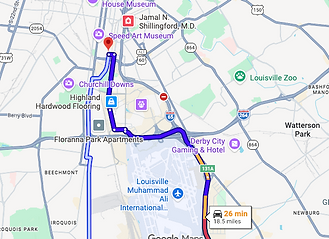
Northbound on 65
Westbound on 64

01
Teaming & Support: Feedback on Assignment
Friday, June 5
530p-900p
02
Ethics--Where do I Stand?Saturday, June 6
900a-1200p
03
Annual Member Meeting & Lunch
Saturday, June 6
1215p-215p
04
Expansion Techniques: Crafting Your Space
Saturday, June 6
230p-530p
SCHEDULE
PRESENTER
Bill F. Ross, III
Bill F. Ross III, M.S. is currently the CEO and owner of Humphrey & Ross Publishers, LLC. A niche market publishing company based in Ocala, Florida. In addition, he is one of the primary authors for one of the most recognized texts in the field of interpreting, You Want to be an Interpreter? (5th Ed.). As a child of Deaf parents, he has been interpreting for 40+ years and holds national certification from the Registry of Interpreters of the Deaf. Previously, Bill was the Vice President of Hands Up Communications, an all-access language company – managing the Florida location since opening in August 2021. Prior to working at Hands Up, Bill was the Curriculum Development Specialist for Deaf Bible Society (DBS); an international organization that provided training/resources for individuals translating Scripture into sign language. He came to DBS from North Central University in Minneapolis, Minnesota where he was the Program Director of the Carlstrom Interpreter Training Program. Mr. Ross formerly held the position of Director of the Communication Access Support Services (CASS) Department at North Carolina School for the Deaf (NCSD); where he established the NCSD Mentorship Project to provide ongoing support to educational and community interpreters. He is passionate about building mentoring relationships, studying American Sign Language and accompanying interpreters on their interpreting journey.
Workshop Descriptions
ETHICS--WHERE DO I STAND?
Do you ever feel like making an ethical decision is a little bit like walking through a minefield? We often wonder if we
have a responsibility to “let go” of our personal beliefs when we work as an interpreter. This workshop will help us
identify the criteria that determine whether a genuine conflict exists. Each participant will consider ways to guide
their individual decision-making process. It is important to recognize that our personal beliefs and values do make a
difference when we encounter ethical dilemmas. Yet, many of us have been left wondering if the decisions we made
were right or wrong; good or bad. We will recognize what it means to hold a sacred trust as professionals and how
we maintain that trust. Throughout the training we will examine and discuss ethical scenarios, these open discussions
will help us determine how to prevent ethical explosions from rocking our world!
EXPANSION TECHNIQUES: CRAFTING YOUR SPACE
American Sign Language and spoken English are very different languages and to achieve message equivalency
interpreters must incorporate expansion techniques into their interpretation. The seven recognized expansion
techniques are: contrasting, faceting, reiteration, utilizing 3d space, explaining by example, couching, or scaffolding,
and describe then do. The goal of expansion techniques is to improve clarity – they are used in order to make implicit
information in the source language more explicit in the target language. In this workshop we will unpack all of the
expansion techniques, but we will focus our energy on utilizing 3D space, which is invariably coupled with classifiers.
If interpreters are unfamiliar with expansion techniques, the resulting work will demonstrate unnatural phrasing,
incorrect grammatical structures, and errors in production. During this workshop interpreters will be exposed to all
of the expansion techniques, yet we will focus our energy on correctly using classifiers, 3D-space, and scaffolding all
found in the accurate use of American Sign Language.
TEAMING AND SUPPORT: FEEDBACK ON ASSIGNMENT
It is critical for colleagues to have the ability to work together as members of a team while interpreting. Observationand feedback are important elements of collaborative teamwork. Mastering the skill of depersonalizing feedback iscritical for trust building, support, and open communication. Since we are often placed settings that are bothphysically and cognitively demanding we must be able to rely upon our colleague for support. The words we choose when providing support and feedback to our colleagues can encourage or discourage them; therefore, utilizingspecific terms and phrases lends to the feedback being expressed and received in a more work focused manner. Thistraining will address team interpreting, positive regard, trust as a professional courtesy and utilizing the open modelof interpreting. Participants will be provided with an opportunity to expressively interpret then provide observationalcommentary using the concepts and language of the workshop.